
 While the idea of linking aesthetic taste to class is really interesting, Bourdieu does an excellent job of making it incredibly boring with winding sentences that could have used serious editorial assistance and over-analyzed data.
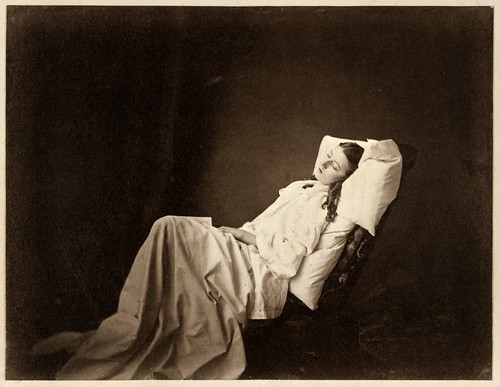
The only section that I thought was truly compelling—and only because I love photography, not because of Bourdieu’s writing skills—was the section on photography. First, I thought that his reason for using photographs—“partly to avoid the legitimacy-imposing effects of paintings and partly because photography is perceived as a more accessible practice, so that the judgments expressed were likely to be less unreal” (39)—was something to consider. The controversy of whether or not photography is actually an art has haunted the medium throughout its existence. Invented in 1839, the daguerreotype was actually an image that was developed onto metal plates, followed closely by the cyanotype and the albumen silver print. Some argue that photography in its incipience was more aesthetic because it took more effort on the part of the photographic artist, not only in terms of capturing the image, but also in developing the print. Additionally, the first images were often composite images, meaning that the final photographic image was actually produced by layering several different photographs of the same image, as demonstrated with Henry Peach Robinson’s Fading Away, 1857, above (there were several more stages to compositing this photo, the reclined woman [also developed on its own as She Never Told Her Love, and showed at it the same exhibition], each of the women framing the reclined woman, and the man at the window, but I couldn’t find all of the stages). So the value of the image corresponds to the amount of effort the artist has to invest in his or her work. The idea of accessibility though, both in terms of artist and audience (that is, it takes less skill to produce a photograph than a painting, and it’s easier to interpret something that seems quotidian than it is to give an opinion of an objet d’art)—especially in the digital age in which anyone with a Nikon can capture a beautiful image—results in the devaluation of the medium as a whole. Photography, then, is often considered inferior to other media, which led Bourdieu to call it a middlebrow art (Photography: A Middle-Brow Art).
I thought the most intriguing part of this section, though, was the interviewees responses to the image of the woman’s hands. The lower-class respondents saw arthritis and deformation, then people of a slightly higher class saw a woman who had worked too hard in her lifetime, and the elites saw something reminiscent of van Gogh’s work or Flaubert’s servant woman. I thought it was interesting that the people of the upper-class actually saw the hands as something truly aesthetic, associating it with the works of established artists. It was funny that the everyday reality of the lower classes fuels the aesthetic of the upper classes.

No comments:
Post a Comment